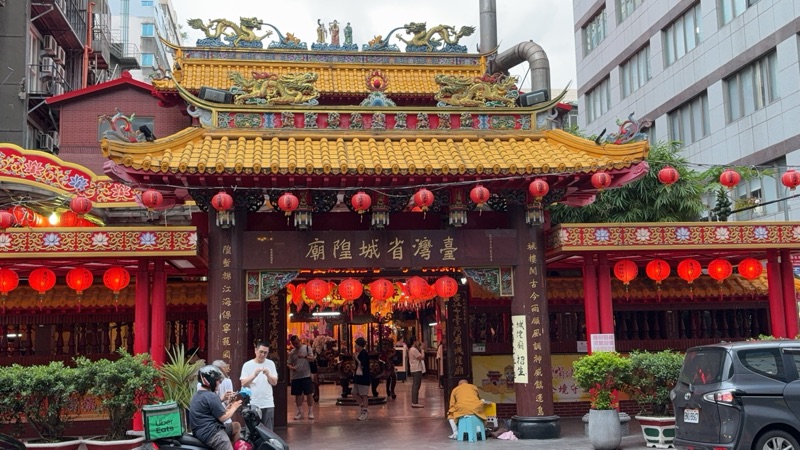
 Most of you will know that I recently moved, from Yuquan to Guangfu.
A few streets, from one Taipei into another.
Most of you will know that I recently moved, from Yuquan to Guangfu.
A few streets, from one Taipei into another.
For years I lived in Yuquan (玉泉里), on the southern edge of Dadaocheng (大稻埕). I now live in
Guangfu (光復里), inside the old walls of Taipei City (臺北城). No river crossed, no hill climbed: only
a few streets east.
Yuquan is warehouses, hardware, spare parts, wholesalers and old
family firms. Its streets still obey the Tamsui River (淡水河): goods arrive, change hands, acquire
credit and move on. Guangfu is gates, government offices, public markets,
hotels, bookshops, banks, schools and pork-chop rice served to people whose
lunch break has an ending.
Both belong to western Taipei (臺北西區); both are sold as "the old
city". They are not old in the same way. Yuquan grew around goods and
private capital; Guangfu around files, public authority and salaries.
The map shows a short walk. The city shows a river port and a city
gate, merchants and mandarins, inherited property and the state payroll. One of
the shortest border crossings I know.
Ian Nairn distrusted the flattening effects of modern planning. He
defended the contradictions that give a place its charge. Western Taipei would
have pleased him. Its disorder is not a failure to become one city. It is
evidence that several cities, built by rival systems of power, still occupy the
same ground.
Names that remember, names that command
The distinction begins with the names.
"Yuquan" suggests a jade spring. Its origin is less
romantic: Izumicho (泉町), or "Spring District", imposed during the Japanese
colonial administration's renaming of Taipei in 1922.
Before 1922, the names described the ground. Hegoutou Street (河溝頭街) marked the head of
a drainage channel; Ximenwai Street (西門外街), the space beyond the West Gate; Jiangbin Street (江瀕街), the road beside
the river. Mud and river water remained inside the words.
Izumicho flattened those local biographies beneath the colonial
surveyor's plan: several places, one neat Japanese administrative name.
After 1945, power changed hands. The Nationalist government
abolished the Japanese district system, erased one colonial vocabulary and
installed the auspicious language of Chinese tradition. It kept
"spring" and placed "jade" before it. Izumicho became
Yuquan - Jade Spring.
The boundaries were redrawn repeatedly. Today's Yuquan contains
fragments of Minatocho (港町), Eirakucho (永樂町) and Taiheicho (太平町). It is not Izumicho preserved intact. Yet however often the city
has been cut apart and reassembled, the spring remains on the map: a
geographical ghost, a final act of defiance.
Guangfu follows another logic, and another arrogance of power. The
word means "restoration" or "recovery", the Nationalist
term for the end of Japanese rule. It describes no river, street, trade or
position. It announces how the state has chosen to interpret history.
After 1945, Restoration, Nation-Building, People and China appeared
on roads, schools and neighbourhoods across Taiwan. Their political value lay
in their local emptiness: they could be placed anywhere because they belonged
nowhere.
The mechanism is familiar beyond Taiwan. Regimes rename streets
because possession of the map rehearses possession of memory. Guangfu's bland
correctness conceals unusual density. It covers fragments of Kitamoncho (北門町), Kyomachi (京町), Yamatocho (大和町), Sakaemachi (榮町) and Nogicho (乃木町). Within a few
blocks stand the North Gate (北門, formally Cheng'en Gate 承恩門), Futai Street Mansion (撫臺街洋樓) and Zhongshan Hall (中山堂), formerly the Taipei Public Auditorium (臺北公會堂). Qing fortification, Japanese empire,
post-war authoritarianism, commerce and transport speak at once.
The name supplies one official answer. The buildings continue to ask
questions.
The losers who inherited the port
Dadaocheng began not with a plan, but a commercial feud and a
violent defeat.
In 1853, settlers from Fujian fought for control of the river trade
in Bangka (艋舺), now Wanhua (萬華). The "upper guilds", associated with three counties of
Quanzhou (泉州府), attacked merchants from Tong'an (同安), the "lower guilds", after
passing through the Qingshui temple precinct (清水巖祖師廟). The Tong'an side lost. Its leader,
Lin Youzao, fled north with his people and the statue of the Xiahai City God (霞海城隍). They settled on
an open threshing ground called Dadaocheng and built another port.
The winners secured Bangka. The losers secured the future.
As Bangka's river silted up, larger vessels struggled to berth.
Dadaocheng was better placed when the port of Tamsui (淡水港) opened to foreign trade in 1860. Tea,
camphor, textiles, sugar, preserved foods and imports moved through its quays.
British and American firms established trading houses along Guide Street (貴德街) and today's Nanjing
West Road (南京西路). Foreign commerce and consular activity drew in compradors -
brokers between foreign firms and Taiwanese trade - together with tea
merchants, warehouse owners, boatmen, accountants and labourers.
This was more than a market. It was a system. Cargo required
storage; storage required land; long-distance trade required credit,
information and trusted intermediaries. Profit moved from shipment to shop,
from shop to property.
The colonial Railway Department (鐵道部), station and rail network later
redirected movement from water to land without immediately displacing the
river. For a time, wharf, railway, gate and market worked together.
Dadaocheng's southern edge became a hinge between transport regimes.
In Yuquan, goods did more than move. They learnt to reproduce
themselves as capital.
When a trading house outlives the trader
The Zhuang family makes the process visible.
Its ancestors arrived from Tong'an in 1746 and settled at Bali (八里坌), across the Tamsui.
After the fighting of 1853, the family established Yifang Trading House (義芳行) in Dadaocheng,
trading with Hong Kong and Xiamen in sugar, Eagle Brand condensed milk, Kirin
beer, olives, flour and other imports.
In 1921, the business became Zhuang Yifang Trading Company (莊義芳商事株式會社), adding
property sales and rentals. In 1932 it helped establish the Eirakucho Shop
Building Credit and Purchasing Co-operative (永樂町店舖建築信用購買利用組合), an early attempt to remake
Taipei's commercial fabric. Three years later the family joined tea merchant
Chen Tianlai to finance the First Theatre (第一劇場), one of only two major theatres operated
by Taiwanese proprietors.
The business survives, transformed, as the Lung Yuan Group (隆遠集團). Eight generations
after the family's arrival, its holdings extend across metropolitan Taipei.
A cargo of tea yields one profit. A trading house yields profits
repeatedly. Land, rent and shares continue after the person who struck the
bargain is dead. Wealth detaches itself from one body and acquires a life of
its own.
Dadaocheng was never uniformly rich. A capitalist city requires
clerks, porters, tea pickers, bookkeepers, artisans and servants. A few
families controlled goods, land and credit; many supplied labour. Merchant
houses and poverty did not contradict one another. Each made the other
possible.
The street shows both. Yihe Tai trading house (怡和泰商行), with
yellow-green tiles, arched windows and floral medallions, turned its facade
into a declaration of solvency. Chen Tianlai's residence (陳天來故居) became a Japanese
model of the Taiwanese home. Beneath such facades, the arcade remained a
workplace: boxes against columns, handcarts and lorries competing for space,
merchandise spilling into the street.
Yuquan retains this structure. Hardware, spare parts, wholesalers,
warehouses and old shop-houses still operate. The street is not arranged for
the camera. Doors must open, lorries unload, rent be paid. Heritage aesthetics
come later.
This history is not under museum glass. It sweats, stains the
pavement and double-parks.
Capital beyond money
Dadaocheng's greater achievement was not private fortune, but a
public sphere financed by it.
Trade carried information with tea. It supported literacy,
newspapers, doctors, lawyers and local notables. Li Chunsheng, a comprador who
made his fortune through foreign firms, expanded the tea trade, assisted the
reforming governor Liu Mingchuan and mediated religious and commercial disputes
as a Christian in a largely non-Christian society.
In the 1920s, Chiang Wei-shui opened Taian Hospital (大安醫院), later an
important base for the Taiwanese Cultural Association (臺灣文化協會). Reading rooms, lectures, newspapers
and modern theatre required ideas; they also required halls, printing presses
and networks. Merchants and intellectuals met at Shanshuiting restaurant (山水亭), the First Theatre
and the district's cafes.
Capitalism produced brutal inequality. It also paid part of the cost
of civic culture and political opposition. The port that connected Taiwanese
tea to the world gave Taiwanese people the means to argue about their place in
it.
Through the North Gate
Walking east from Yuquan, the real boundary is not the line between
Datong (大同區) and Zhongzheng (中正區). It is the North Gate.
When the Qing completed Taipei's walls in the late nineteenth
century, the gate divided two urban orders. Outside: Dadaocheng, river,
wharves, private trade. Inside: governor's offices, provincial administration,
barracks, state.
In 1892, Governor Shao Youlian spent 20,000 silver taels on the
Qinchai Xingtai (欽差行臺), a reception compound for imperial commissioners. Red tiles and
swallowtail roofs made political theatre from timber and brick. Japanese troops
entered through the North Gate in 1895; the compound became the first
headquarters of the colonial Governor-General, serving until the new
Governor-General's Office - today's Presidential Office Building (總統府) - was completed in
1919.
The Japanese administration demolished most of the walls and
replaced them with broad boulevards. Railways and the station changed Taipei's
scale and direction. Today the surviving gate takes seconds to cross. Inside
and outside have merged into asphalt. Their institutions have not.
Futai Street Mansion combines local Qilian sandstone (唭哩岸石), an upper timber
storey and a Mansard roof cut by dormer windows. Its classical arcade and
European Renaissance references belong to a city staging imperial modernity.
Nearby Sakaemachi, around Hengyang Road (衡陽路), was the "Ginza of Taipei".
Restaurants, cafes and fashionable shops served officials, professionals and
businessmen. In 1932, Eiji Shigeta opened the seven-storey Kikumoto Department
Store (菊元百貨店), known to Taiwanese customers as the "seven-storey
heaven". It had Taiwan's first publicly accessible commercial passenger
lift and was, for a time, the island's tallest privately owned building. The
Taipei Public Auditorium followed in 1936, giving the colonial capital a
monumental civic stage.
This Taipei was prosperous and modern. The question is not whether
it had money, but where the money came from.
The city of salaries
Chengzhong (城中區), the old centre containing Guangfu, prospered through concentrated
authority, public budgets, banks, infrastructure and salaried elites. Officials
drew stipends; police and soldiers received pay; professionals depended on
institutional positions. Department stores, hotels, bookshops, foreign firms
and cafes served a population whose income arrived at regular intervals.
Dadaocheng belonged to capital. Chengzhong belonged to salary.
The distinction is structural, not demographic. Dadaocheng was never
uniformly rich, nor Chengzhong uniformly poor. The difference is the source and
durability of wealth. Capital makes land, companies, rent and dividends work in
the owner's place. Salary, however generous, still requires the sale of time
and expertise.
A title cannot collect rent. A memorandum does not appreciate for
the benefit of one's children.
For people without a family business, shop-house or land, the civil
service converted education into office, office into status, status into
reliable cash flow. A clear staircase of social mobility, with an equally clear
ceiling. Dignity, security and pension were attainable; wealth that continued
working after its owner stopped was harder.
Family money changed the equation. For the already wealthy, office
supplied status, respectability, networks and access to power. Two officials at
the same grade, on the same salary, could belong to different classes: one with
an inherited flat in Xinyi (信義區), family land in Da'an (大安區), a housing deposit supplied by parents or an existing investment
portfolio; the other with salary alone.
The class divide hides behind an equal payslip.
Power and pay are also unequal. A mid-ranking official in Guangfu
may determine whether a plot in Yuquan can be developed, when a valuable
licence is issued, who wins a public contract or how costly an inspection
becomes. The economic consequence may be immense; the legal income remains
confined to a salary scale.
This does not excuse corruption. It explains the need for
transparent procedure, credible oversight and pay proportionate to
responsibility. Administrative power acquires a price when it alters another
person's costs and profits. Unless law prevents that price from becoming
private income, it returns as patronage, influence-peddling or bribery.
The buildings make authority monumental. The person exercising it
remains exposed to inflation, school fees and housing costs. Power without
capital is not wealth. Unless there is family money behind the salary.
That mismatch is Guangfu's central tension.
Private dining, pork-chop rice
Food makes the distinction visible.
Dadaocheng offers reservation-only dining, elaborate tea services,
mullet roe and sweets sold with history attached. Ziyang (滋養和菓子), a post-war maker
of Japanese-style wagashi that later moved into Dadaocheng, is not a surviving
Qing merchant house. It fits the district because craft, memory and place can
be converted into distinction, then price.
Wealthy merchants always needed banquets and places where
hospitality could soften business. The audience and vocabulary have changed.
Old shop-houses are now stages; provenance, technique and family memory justify
the premium. Capital extracts another return from the past.
Guangfu's pork-chop rice, hand-cut noodles, breakfast shops and
inexpensive clothing serve another economy. Civil servants, office workers,
students, travellers and market traders need a known price, adequate portion
and predictable time. The meal is not culturally inferior. It is designed for
salaried time.
Dadaocheng sells time arranged as an experience. Chengzhong sells a
meal that will not delay the next obligation. One turns history into margin;
the other restores labour for tomorrow.
History: premium or repair bill
Dadaocheng's revival is described through creative industries,
tourism and conservation. It was possible because the district already
possessed assets that could be repriced: shop-houses, land, trading names, tea,
temples and family histories.
Capital can wait. A building remains neglected until the market
learns to desire "old Taipei", then returns as restaurant, gallery or
boutique. Decay becomes scarcity; memory becomes brand.
Planning law helps. In Dadaocheng's designated historic district,
transfer of development rights moves unused building potential from protected
sites to other plots. Conservation carries costs, but can also create tradable
value. Continuous street fronts, surviving trades and an established tourist
route make the past legible, then saleable.
Guangfu's past is harder to sell. It remains inside offices, hotels,
markets and buildings with ordinary work to do. The North Gate, Futai Street
Mansion and Zhongshan Hall bring protection, height limits and development
constraints. Ownership is fragmented; repairs expensive; assembly difficult.
Daily operations cannot stop while someone invents a heritage narrative.
The same old building sits on two balance sheets. In Dadaocheng, age
adds a premium. In Chengzhong, age adds maintenance. One district makes history
visible; the other keeps the system running.
Tax data prevent rich merchants and poor officials from becoming a
cartoon. In Yuquan and neighbouring Yongle (永樂里), average declared household income stands
far above the median: a small number of asset owners lift the mean. Guangfu is
even more dispersed, combining high professional incomes, rent, business
holdings and post-war property. A bureaucratic city does not mean every
resident lives on one government salary.
The numbers refine the distinction. Class is not one year's average
income. It is whether income can detach itself from continued labour, and
whether wealth can pass intact to the next generation.
The state changes language, not address
Japan's defeat in 1945 did not reverse the old city's political
character. It replaced the occupants.
The Governor-General's Office became the Presidential Office. The
governor's residence became Taipei Guest House (臺北賓館). Japanese official housing passed to the
Republic of China's military and political elite. The former naval officers'
residences (海軍將官官舍) later housed senior commanders including Ma Jizhuang and Li Yuxi.
Across Taipei, the state created military dependants' settlements
for the population arriving with the Nationalist government. Beitou's Heart
Village (中心新村) reused Japanese military medical facilities. Chenggong New Village
(成功新村), built by
the army, later became modern public housing. Allocation followed bureaucratic
rank and institutional affiliation, not the market.
Chengzhong continued to depend on ministries, schools, postal
administration, transport agencies and state-linked finance. Japanese colonial
officials gave way to civil servants speaking Mandarin in different provincial
accents. Kikumoto became the China Products Company (中華國貨公司), then housed the Friends of the Armed
Forces Association (軍人之友總社). The signs changed. The salaried city endured.
The state never left the old centre. It changed uniform.
Across the invisible wall
From the North Gate, I can look west to Yuquan and east to Guangfu.
West: lorry exhaust, machine oil, goods, risk, accumulated private
wealth. East: office workers and bank employees, one form, one meeting, one
lunch break at a time.
Jonathan Meades wrote that Nairn treated architecture as
"deflected autobiography": an argument with oneself through
buildings. These streets now read that way to me. Not an abstract urban
history, but a map of where I have lived, what I inherited and which forms of
security I recognise.
The walk from Yuquan to Guangfu crosses no physical barrier. It
crosses two philosophies of survival. Dadaocheng turns disorder into
opportunity, profit and inheritance. Chengzhong turns education, discipline and
institutional service into status and security.
The systems need each other. Capital needs permits, infrastructure
and law. The state needs taxes, commerce and salaried obedience. Each distrusts
the other's claim to legitimacy: the merchant sees an official controlling
value without creating it; the official sees a merchant converting private
advantage into hereditary power.
A few streets apart, they face each other across a city wall that no
longer exists and never entirely disappeared.
留言
張貼留言